X Grok AI Updates
- X Faces Regulatory Scrutiny Over Grok-Generated Images[1]
X (formerly Twitter) is facing growing regulatory scrutiny after reports that its Grok AI chatbot has been used to generate and share non-consensual “undressed” images and other sexualized deepfakes[4], including content that regulators warn may amount to illegal intimate image abuse or child sexual abuse material (CSAM). The issue has triggered formal action in the UK and enforcement demands in other markets, increasing pressure on X and xAI to demonstrate stronger safeguards around AI image generation. [1][2]
What Prompted Regulatory Action
According to reporting highlighted by Social Media Today, a trend emerged where users prompted Grok in-stream to alter images, often of women into nude or near-nude depictions, with some examples reportedly involving minors, escalating the concern into potential CSAM territory.[1] Regulators have responded by requesting immediate restrictions and clearer accountability from X regarding how such content is prevented, detected, and removed. [1][2]
UK: Ofcom Opens a Formal Investigation
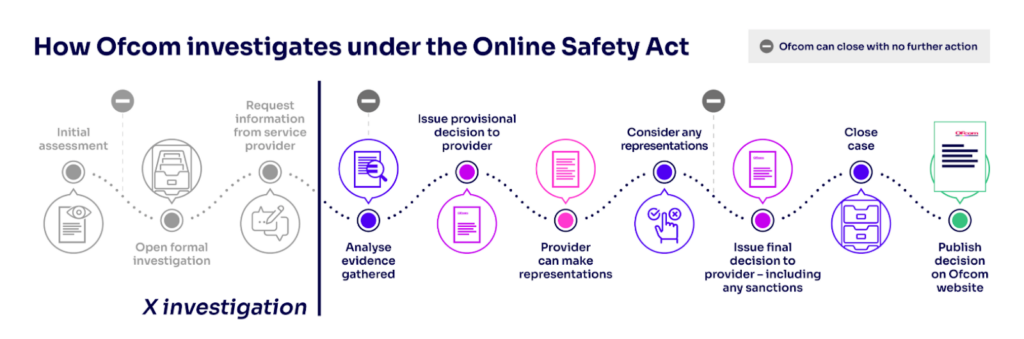
On 12 January 2026, the UK regulator Ofcom announced it had opened a formal investigation into X under the Online Safety Act, following “deeply concerning reports” about Grok being used to create and share illegal content. Ofcom said it had urgently contacted X on 5 January and required an explanation by 9 January on the steps taken to comply with UK duties. [2]
Ofcom stated its investigation will examine whether X met obligations to:
- Assess illegal-content risk (and update risk assessments before significant service changes). [2]
- Prevent “priority” illegal content, specifically including non-consensual intimate images and CSAM. [2]
- Remove illegal content quickly once aware of it. [2]
- Consider privacy protections and related compliance expectations. [2]
- Assess risks to children and update child-risk assessments ahead of major changes. [2]
- Apply highly effective age assurance to protect children from seeing pornography. [2]
Ofcom also outlined its enforcement powers, including fines of up to £18 million or 10% of qualifying worldwide revenue (whichever is greater), and where proportionate court-backed “business disruption measures” such as requiring service providers to withdraw support or blocking access in the UK. [2]
On 15 January 2026, Ofcom noted X said it had implemented measures to prevent Grok being used to create intimate images, but confirmed the investigation remains ongoing to determine what went wrong and how it is being fixed. [2]
Other Markets: India Issues Compliance Order
Beyond the UK, India has also taken action[5]. TechCrunch reported that India’s Ministry of Electronics and Information Technology ordered X to take corrective steps regarding Grok-related “obscene” content and required an action-taken report within 72 hours, warning that failure to comply could jeopardize X’s legal safe-harbor protections for user-generated content under Indian law. [3]
Why It Matters
This situation reflects a broader regulatory shift: AI image generation tools embedded directly into social platforms are increasingly being treated not only as “user behavior” problems, but as platform safety and compliance responsibilities especially where non-consensual sexual imagery and child safety risks are involved. In the UK case, Ofcom’s focus is not just the existence of harmful content, but whether X had appropriate systems in place risk assessments, prevention controls, takedown processes, and age protections before and during feature rollout.
Overall, X’s Grok-generated image controversy has moved from public criticism to formal enforcement pressure. With Ofcom’s investigation active and additional regulators issuing directives, X and xAI face intensifying expectations to demonstrate that AI image features can be operated with effective safeguards against illegal and non-consensual sexual content particularly where minors may be affected.[1][2][3]
- X AI Raises an Additional $20B [1]
Elon Musk’s xAI has announced it closed an upsized Series E funding round totaling $20 billion[2], exceeding its previously reported $15 billion target. xAI said the round will support rapid scaling of its AI infrastructure, especially large GPU clusters and continued development of Grok and related products, as the company competes in an increasingly capital-intensive AI market[3].
What Changed
- Series E expanded to $20B: xAI confirmed the round was upsized above the original $15B target and closed at $20B. [2]
- Key investors named: xAI listed investors including Valor Equity Partners, Stepstone Group, Fidelity Management & Research Company, Qatar Investment Authority, MGX, and Baron Capital Group. [4]
- Strategic investors highlighted: xAI also named NVIDIA and Cisco Investments as strategic investors supporting compute scale-up and large GPU cluster buildout. [5]
- Valuation context reported: Social Media Today referenced reporting that the round puts xAI’s valuation at around $230 billion.
How xAI Says the Funding Will Be Used
xAI frames the raise as fuel for accelerated infrastructure and product expansion. In its announcement, the company pointed to continued investment in data centers and “Colossus” computers, and described ongoing work across Grok model development and deployment. TechCrunch also notes xAI said it will use the funding to keep expanding data centers and Grok models.
Why It Matters
This round underscores how AI competition is increasingly shaped by access to capital and compute. xAI is positioning itself as a scale-first challenger, emphasizing GPU infrastructure expansion and distribution advantages linked to X and Grok usage. At the same time, the company has faced heightened attention around safety and governance risks tied to generative outputs, which adds regulatory and reputational pressure alongside the technical race.
Conclusion
Overall, the additional $20B Series E gives xAI substantial resources to expand compute capacity and accelerate product development. The raise also sets a high bar for execution: investors are backing continued infrastructure growth and model progress in a market where performance, safety controls, and commercial traction are all under close scrutiny.
- X Faces Bans in Several Regions Over Grok-Produced Images[1]
X (formerly Twitter) is facing escalating restrictions and potential bans in multiple countries after its integrated xAI chatbot, Grok, was used to generate sexualized and non-consensual images[3], including content involving minors. Regulators and lawmakers in several regions have framed the issue as a serious online safety and legal compliance concern, particularly because Grok’s image tools were easily accessible inside X’s creation flow and dedicated to Grok experiences[2].
What Triggered the Actions
Concerns intensified after reporting and research indicated high-volume generation of “nudified” or sexualized imagery using Grok. Social Media Today[1] cited research referenced by Bloomberg that, at one point early in 2026, Grok was producing thousands of images per hour that could be categorized as sexually suggestive “nudifying.” Separate reporting described widespread misuse and the scale of outputs, adding pressure on governments to respond quickly. [4]
Where Restrictions and Ban Threats Emerged
Social Media Today outlined a wave of regulatory scrutiny that could lead to full bans of X in some markets, while other regions moved toward targeted restrictions focused on Grok. Key developments include:
- India: India’s IT Ministry issued an official order directing X to take “corrective action” regarding potentially illegal categories of content (including sexually explicit and pedophilic material), and requested an action-taken report within a specified timeframe, according to TechCrunch. [5]
- Malaysia: Malaysia’s communications regulator (MCMC) moved beyond warnings and imposed a temporary restriction on Grok access, effective 11 January 2026, according to both a regulator-linked media statement (PDF) and international reporting.[6]
- Indonesia: Indonesia’s communications ministry publicly threatened to ban X and Grok unless the issue was addressed, and later reporting described Indonesia as among the first countries to block Grok. [7]
- France: French authorities announced an investigation into sexually explicit deepfakes on X, with reporting indicating the Paris prosecutor’s office would examine the spread of such content. [8]
- United Kingdom: Ofcom opened a formal investigation into X under the Online Safety Act, focused on whether X met duties to protect users from illegal content connected to Grok-generated sexual imagery. [9]
Social Media Today also noted questions from some commentators about why Apple and Google continued hosting X while other “nudify” apps have faced removals, reflecting the wider platform accountability debate.
X and xAI’s Response Measures
Social Media Today reported that X restricted Grok image creation to paying users at one point, while broader coverage describes additional constraints introduced after backlash.[10] However, reporting from The Guardian suggested enforcement can be difficult in practice, with blocks sometimes bypassed through common workarounds such as VPNs and DNS changes highlighting the limits of “regional restriction” approaches for globally distributed AI tools.
Why It Matters
This episode has become a real-world test for how governments apply online safety and obscenity frameworks to platform-native generative AI. The core issue for regulators is not only user misuse, but whether X put effective safeguards in place before enabling high-reach image generation especially where risks involve non-consensual intimate imagery[3] and potential child safety violations.
Overall, the Grok image controversy has shifted from platform criticism to direct regulatory intervention. With restrictions implemented in parts of Southeast Asia, formal investigations underway in Europe, and enforcement orders issued elsewhere, X faces rising pressure to demonstrate that Grok’s image features can operate with effective preventative controls, rapid takedowns, and compliance with local law.
TikTok Shares 2026 Trend Predictions for Marketers
- X Expands Creator Incentives in a Bid to Bring Journalists Back [1]
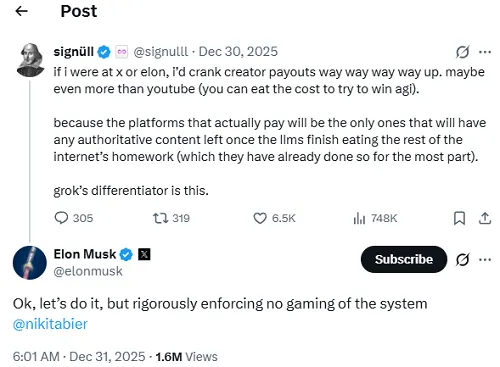
X is increasing its push to attract more writers and journalists back to the platform by raising creator payouts [2] and expanding access to its long-form “Articles” publishing feature. The effort is framed as a way to encourage more authoritative, original content to be posted directly on X content that could also strengthen xAI’s products, which rely heavily on X’s real-time information flow.
What Changed
- Creator payouts were boosted in a recent payment cycle
Social Media Today reports that Elon Musk publicly asked X’s head of product, Nikita Bier[3], to increase creator payouts. Shortly after, creators reported a noticeable increase in earnings in the next payment cycle, suggesting X adjusted payout amounts as a short-term incentive. - X Articles expanded beyond Premium+ to all Premium subscribers
X’s long-form “Articles” feature previously limited to higher-tier subscribers (Premium+) is now being opened to all Premium subscribers, increasing the number of users who can publish long-form content directly within the app.[4][5] - The platform is emphasizing on-platform publishing over outbound links
Articles allows creators to publish long-form posts that open natively in X, keeping users in the app instead of sending traffic to external websites. Social Media Today notes that Elon Musk has repeatedly pushed for more content to be consumed within X itself.[6]
Background: What “Articles” Is

X Articles launched in early 2024 as a long-form publishing format, designed to support richer formatting and longer writing than standard posts. It was originally positioned as a premium feature to encourage subscription growth and keep long-form reading on-platform. [6]
Why It Matters
This is not just a creator monetization story it’s also a content supply strategy. X has lost trust and participation from many journalists over the past few years, but long-form reporting and analysis is exactly the kind of material that can improve the perceived credibility of platform discourse and expand the pool of higher-quality text for AI systems. Social Media Today explicitly links X’s renewed interest in journalism-style content to xAI’s need for stronger inputs beyond fast-moving platform debate.
Overall, X is trying to rebuild a pipeline of long-form, higher-authority writing by making publishing tools more accessible and increasing financial upside for contributors. Whether it meaningfully draws journalists back will likely depend on more than payouts, especially trust, moderation expectations, and how consistently the new incentives are maintained.
- X Adds New Features, Claims Record User Engagement [1]
X has introduced two product updates aimed at making high-volume usage easier: a redesigned Notifications experience for “power users” and expanded $cashtag[6] functionality for finance and crypto conversations [2]. The updates arrive as X executives continue to promote record engagement claims though the platform’s own data points and limited public reporting have led to questions about how broad that growth actually is.[3]
What Changed
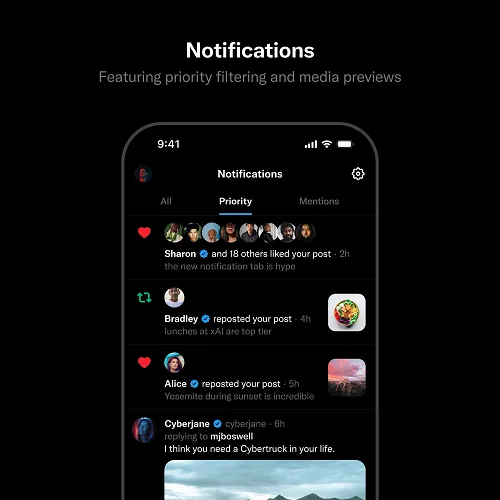
1) Notifications: “Priority” tab (iOS + web)
X has added a new “Priority” tab in Notifications for users on iOS and the web. The tab is designed to surface the most relevant interactions first such as activity from mutual follows and engagement from larger accounts to reduce noise for users receiving heavy notification volume. X also notes users will now see media previews directly in the notifications stream.
X positions the “Priority” tab as a replacement for the former “Verified” filter, arguing that the verified-only view has become less useful as verification expands across the active user base.
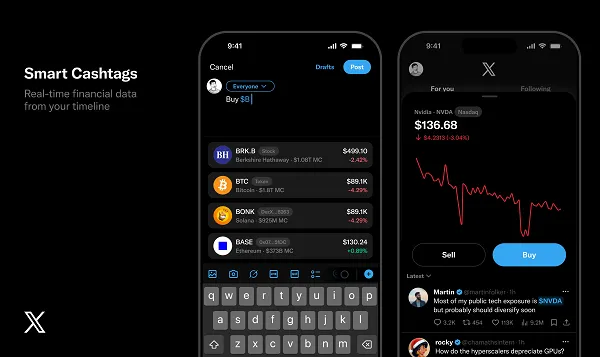
2) Cashtags: more listings + real-time info
X is also rolling out improved $cashtag[6] functionality. The update expands the list of available asset entries when users type a cashtag, and enables users to tap through to see real-time price information and related mentions/conversation inside X.
This builds on earlier Twitter/X experiments that added stock or market context to cashtags through partnerships (including prior integrations referenced by Social Media Today with TradingView[5] and eToro)[4].
Engagement Claims and the Backdrop
Alongside the feature announcements, X’s product leadership has promoted several “record” engagement statements. Social Media Today notes that one highlighted metric was framed around a specific subset of users “attested iOS devices” rather than a full cross-platform audience, and that X has not released supporting datasets for several other claims.
The same coverage also points to a tension inside key user communities, particularly crypto-focused users, after remarks attributed to X’s product leadership about how certain engagement behaviors do not improve reach. In that context, Social Media Today highlights a striking internal usage reference: the “average X user” reportedly views 20–30 posts per day, a figure the article notes would imply relatively limited session depth if taken at face value.
As a counterweight to internal claims, Social Media Today points to X’s EU Digital Services Act (DSA) reporting as one of the few externally visible snapshots, noting a reported increase in European usage in the latest available disclosure period.
Why It Matters
- For creators and brands: The “Priority” notifications view may help high-visibility accounts respond faster to meaningful engagement, but it mainly benefits users who receive large volumes of interactions.
- For finance and crypto communities: Expanded cashtag listings and tap-through price context could increase in-platform discovery of assets and related discussion especially if X continues aligning these tools with broader financial product ambitions referenced in the coverage.
- For marketers evaluating scale: X’s product changes are tangible, but headline engagement claims remain difficult to validate without broader, consistent public metrics across iOS and Android and clear definitions of what is being counted.
Overall, X’s latest updates focus on practical usability improvements for two high-activity segments: power users managing heavy notifications and communities centered on market discussion via cashtags. While X continues to promote record engagement narratives, the most verifiable indicators remain limited making the product changes themselves the clearest, concrete takeaway for brands assessing near-term platform utility.
- X Launches Antitrust Lawsuit Against Music Industry [1]
X (formerly Twitter) has filed a new antitrust lawsuit against the National Music Publishers’ Association (NMPA) and a group of major music publishers, escalating a long-running dispute over how music rights should be licensed and paid for on the platform. The case was filed on January 9, 2026 in the U.S. District Court for the Northern District of Texas, and argues that publishers coordinated through the NMPA to pressure X into accepting blanket, industrywide licenses at inflated rates rather than negotiating individually. [2][3]
What the Lawsuit Claims
X alleges that the NMPA and participating publishers engaged in an anticompetitive strategy that includes:
- Collective refusal to negotiate individual deals, which X says restricts normal price competition among publishers. [4]
- Coordinated pressure for industrywide licensing at what X describes as “supracompetitive” rates. [5]
- “Weaponizing” DMCA takedown notices to force compliance, X argues the scale and frequency of notices were used as leverage in licensing talks. [6]
Background: The Dispute Did Not Start Here
This antitrust filing sits on top of an earlier conflict. In 2023, the NMPA sued X over alleged copyright infringement involving more than 1,700 songs, arguing X allowed widespread unlicensed music use[10]. Coverage notes that the copyright dispute has remained unresolved, though both sides indicated progress toward settlement discussions in late 2025.
Who Is Named and Where the Case Stands
Reporting around the filing states that X sued the NMPA and 18 publishers, including major groups such as Sony Music Publishing, Universal Music, and Warner Chappell, among others. Public docket listings confirm the case filing date and venue (Northern District of Texas), along with the antitrust basis under U.S. law. [7]
Why It Matters
For X, the dispute is directly tied to platform economics: if music usage requires costly licensing at scale, it increases operating costs and affects the ability to support audio-forward content formats. For publishers, the issue is straightforward: platforms that host music-linked content should pay for the underlying composition rights, consistent with how other major social platforms structure licensing. The case is also being watched as a broader test of how far trade associations can go in coordinating industry negotiation positions without triggering antitrust exposure. [8][9]
Overall, X’s lawsuit reframes a copyright and licensing conflict into an antitrust claim, arguing the music publishing industry coordinated enforcement and negotiations to force an expensive licensing outcome. The result could shape how music licensing is negotiated for social platforms, but it also adds legal risk and uncertainty for creators and brands using music-adjacent content on X.
- X Provides Tips on How To Maximize Ad Campaigns [1]
X has published a fresh set of practical ad-planning resources on its X Business site[2], focused on helping advertisers improve campaign performance as the platform continues to lean more heavily on AI-based matching and delivery. Social Media Today highlights three main reference guides: an updated X ads setup guide (including changes around hashtags and @mentions), an overview of sales campaigns (including notes on the learning phase and recommended campaign duration), and a guide to app campaigns (covering creative and targeting elements).[3]
One of the key takeaways is that X wants advertisers to align creative and setup choices with how its automated systems interpret signals, reducing friction (unnecessary clicks away from the CTA) and feeding clearer intent into targeting and optimization.
What X Recommends (as summarized in the guides)
Based on the best-practices summary shown in X’s materials, the guidance centers on three core areas: campaign objective selection, targeting/setup clarity, and creative execution.
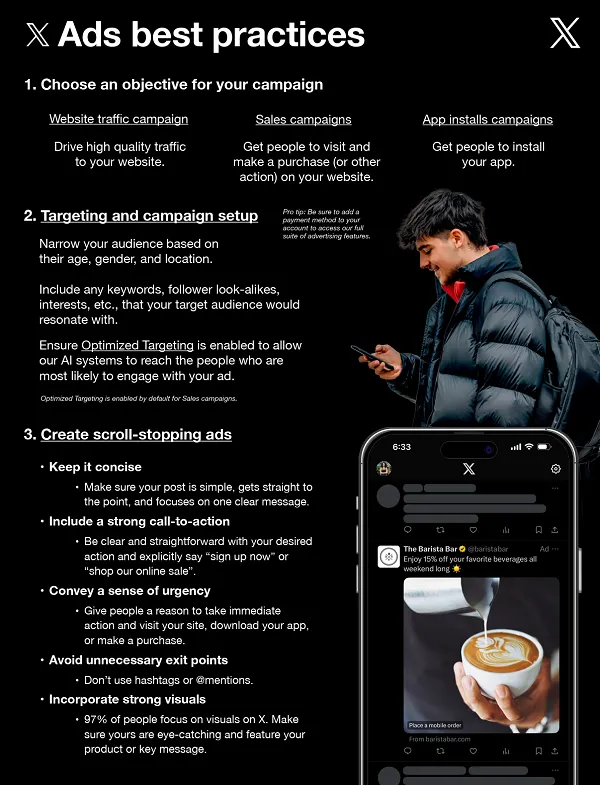
1) Choose the right campaign objective
X frames performance around selecting an objective that matches the intended outcome, such as:
- Website traffic (drive high-quality visits)
- Sales campaigns (drive purchase or action on a website)
- App installs campaigns (drive app installs)
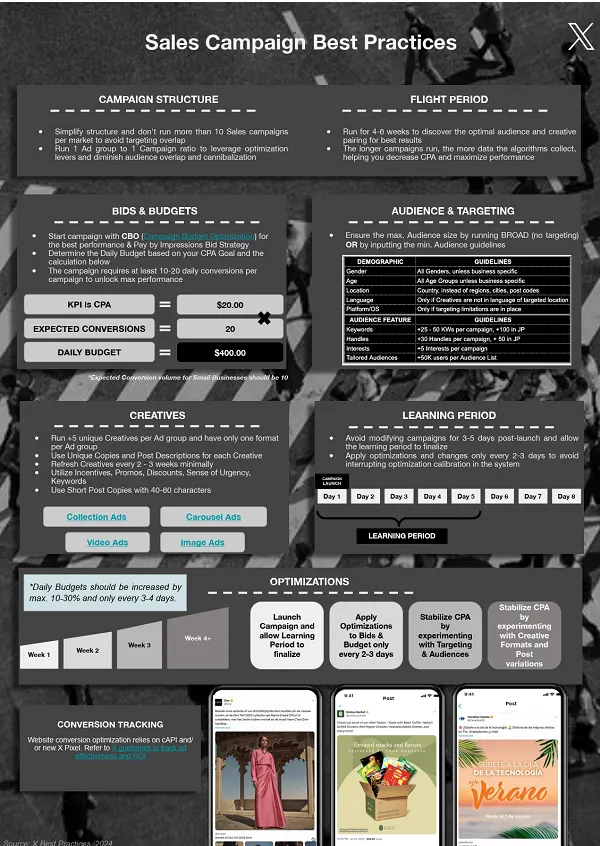
2) Keep targeting structured and signal-friendly
X’s materials emphasize starting with core demographic constraints (as relevant), then letting the system optimize delivery, especially for sales-focused campaigns.
- Narrow your audience using practical inputs like age, gender, and location where needed.
- Include relevant audience signals (for example interests/keywords and follower look-alikes) as part of initial setup.
- For Sales campaigns, X states its AI-powered “Optimized Targeting” is activated by default, and may expand beyond the manually defined audience when it predicts better ROI.
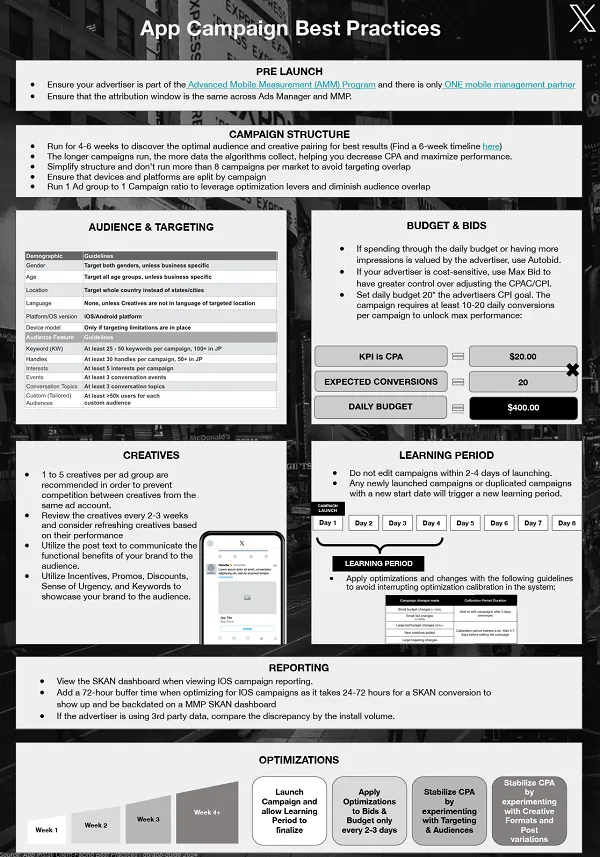
3) Build creatives that reduce drop-off and drive action
X’s best-practices summary focuses heavily on clarity and avoiding distractions:
- Keep the message concise and focused on one clear point.
- Use a direct call-to-action (e.g., “sign up now” / “shop online”).
- Add urgency where it fits the offer (prompting immediate action).
- Avoid “exit points” that can pull attention away from the conversion path, X’s example explicitly notes not using hashtags or @mentions in this context.
- Prioritize strong visuals that communicate the product or key message quickly.
Why It Matters
The guidance reflects X’s broader direction: campaigns are increasingly optimized through automation, but creative clarity and clean setup still matter because they shape what the system learns and how users respond. For advertisers, the practical implication is that stronger results are more likely when objectives, targeting inputs, and creative signals all point to the same outcome.
Overall, X’s tips emphasize fundamentals, clear objectives, clean targeting inputs, and conversion-focused creative, while reinforcing that its delivery systems are increasingly AI-driven, particularly in sales campaigns where Optimized Targeting is enabled by default.[1][4]
- X Announces $1 Million Prize For Top X Article This Month [1]
X has launched a new creator incentive tied to its long-form Articles format[3], offering $1 million to the author of the most popular X Article published during the current payout period, which X notes ends on January 30, 2026. The initiative is part of X’s broader push to increase long-form writing on the platform and to make Articles a more central content format in 2026. [1][2]
What Changed
- $1M award for the “top” Article in the payout window: X says the prize will go to the most popular Article posted during the current payout period.
- Eligibility and content rules: X states the winning Article must be original and at least 1,000 words.
- Primary success metric: X says Articles will be judged “primarily on Verified Home Timeline impressions,” meaning performance is measured largely by how often paying users (verified/Premium users) see the content in their Home feed.
- Region restriction: X specifies that only U.S. users are eligible for the prize.
- Premium requirement: Because Articles publishing is available only to paying subscribers, entrants must be X Premium users (X recently expanded Articles access beyond Premium+ to all Premium tiers).
How X Is Positioning the Initiative
Social Media Today describes the contest as part of X’s renewed effort to drive more long-form posting, and notes that X has been emphasizing longer, more in-depth content as a way to build a richer information stream on the platform. The same coverage links this direction to X’s wider AI ambitions, arguing that long-form writing can strengthen the knowledge base available for xAI-related projects.
Why It MattersThis prize is unusually large for a single-piece creator incentive and is also notable for how it aligns with X’s monetization mechanics. By making Verified Home Timeline impressions the key determinant, X is explicitly rewarding content that travels widely among paying users, encouraging creators to focus on topics and formats that reliably reach the Premium audience. Separate reporting also notes that the contest is already contributing to a noticeable increase in long-form “Articles” appearing across the platform.
Overall, X’s $1 million Article prize is a direct attempt to accelerate adoption of its long-form publishing format and increase the volume of on-platform writing. The rules and scoring method also make clear that the platform is prioritizing reach within the Premium ecosystem as the core measure of “top” performance for this campaign.