- TikTok Adds Teen Safety Measures in EU, Outlines Economic Contribution [1]
TikTok announced new enforcement measures aimed at reducing underage access in Europe, as EU governments and regulators continue to debate stricter social media age limits. At the same time, TikTok published new figures outlining its claimed contribution to the European economy, positioning the platform as a driver of business growth and creative-sector employment across the region. [1]
Social Media Today reported that TikTok’s European rollout will expand technology designed to improve detection and removal of accounts belonging to children under 13, following a pilot program that TikTok said resulted in the removal of “thousands of additional underage accounts.” [1][2]
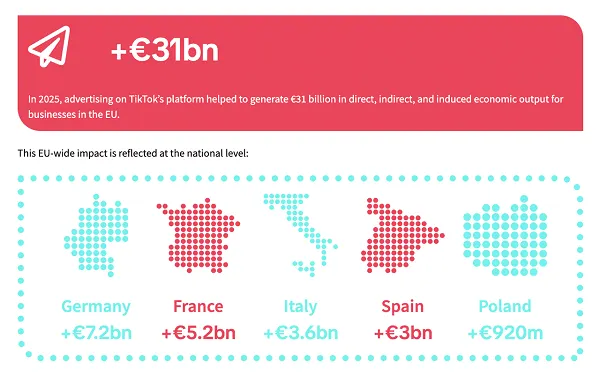
In parallel, TikTok stated that advertising activity on the platform generated €31 billion in economic value across the EU in 2025, citing findings from research conducted by Public First. [1][3][4]
What changed
- Expanded detection and removal of under-13 accounts in Europe (rollout “in the coming weeks”):
TikTok said it will begin deploying enhanced technology in Europe to better identify accounts that may belong to children under 13, then route those accounts to specialist moderator review for enforcement action. [1][2] - Age signals broadened beyond sign-up information:
TikTok stated that its updated detection approach will consider signals such as profile information, the content a user publishes, and other in-app behavioral indicators to assess whether an account may be under 13. [1][2] - Appeal options include multiple age verification methods:
TikTok stated that users can appeal underage removals, and that age confirmation options may include facial age estimation (via Yoti), credit card authorization, or government-issued ID. [1][2] - New EU economic contribution figures published (2025):
TikTok stated it drove €31 billion in economic value across the EU in 2025, including country-level figures such as €7.2bn (Germany), €5.2bn (France), €3.6bn (Italy), €3bn (Spain), and €920m (Poland). [1][4] - Additional claims on business impact and creative jobs:
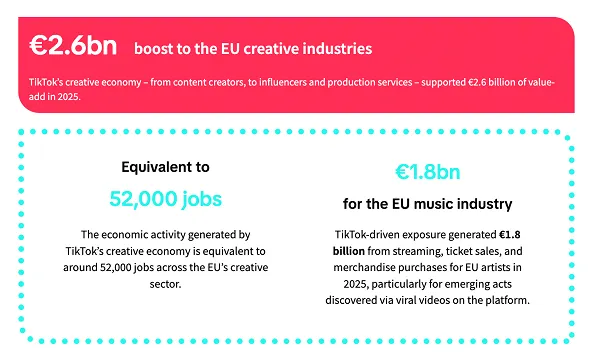
TikTok stated that more than 6.5 million EU businesses used TikTok to grow across borders in 2025, and it cited an estimate of around 52,000 creative-sector jobs supported through the platform’s creative economy. [1][3][4]
Why TikTok is doing this
TikTok’s safety update arrives amid continued EU policy debate around stronger age protections and platform accountability, with multiple countries considering higher minimum ages for social media access. Social Media Today framed TikTok’s rollout as part of a broader effort to demonstrate that platform-level enforcement improvements can reduce pressure for more restrictive legal age thresholds. [1]
The economic contribution publication appears designed to reinforce TikTok’s role as a commercial and cultural channel in Europe. TikTok’s Newsroom statement presents the figures as evidence that the platform supports SME growth, cross-border commerce, and employment in creator-adjacent industries—arguments that frequently appear in policy discussions about platform regulation and societal impact. [3][4]
Practical implications for users, parents, and brands
- More accounts may be reviewed for age compliance:
With expanded detection signals and specialist moderation review, more accounts suspected of being under 13 may be flagged and removed, with appeals handled through structured verification processes. [2] - Higher operational expectations for age enforcement in the EU:
TikTok’s rollout emphasizes proactive detection and verification pathways, which aligns with EU pressure on platforms to demonstrate effective protections for minors and age-appropriate experiences. [1][2] - Economic framing may influence policy and business positioning:
TikTok’s EU economic figures, attributed to Public First research, are likely intended for stakeholders beyond advertisers—supporting a broader narrative about SME benefits, creator-economy employment, and consumer value linked to TikTok-driven discovery. [3][4]
Overall, TikTok’s EU update combines two strategic messages: expanded enforcement technology to reduce underage access, and a quantified case for the platform’s economic value in Europe. The safety rollout focuses on earlier detection, specialist review, and structured verification options, while the economic report emphasizes claimed 2025 outcomes for EU businesses, creators, and national-level economic output. [1][2][3][4]
- TikTok Publishes New Guide to Its AI-Powered Campaigns[1]
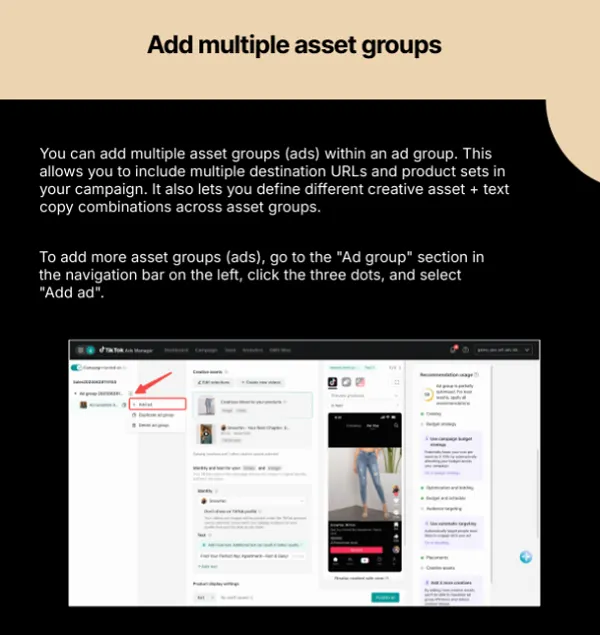
TikTok has published a new advertiser guide focused on its AI-driven Smart+ campaign products, providing a step-by-step overview of how to build, launch, and optimize automated performance campaigns in TikTok Ads Manager. Social Media Today reports that the new document is a 23-page Smart+ guide covering the full Smart+ setup process and optimization guidance, aimed at marketers using TikTok’s machine-learning systems to improve performance outcomes. [1]
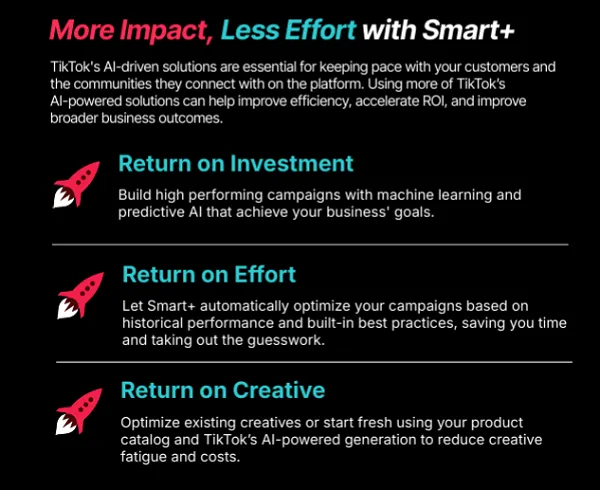
The guide is positioned as practical implementation support for advertisers adopting Smart+ campaign automation—where TikTok’s systems optimize key inputs such as targeting, bidding, and creative selection based on predicted conversion outcomes. [1][2]
What changed
- TikTok released a dedicated Smart+ guide focused on AI-powered campaign execution:
Social Media Today reported that TikTok published a 23-page guide that walks through Smart+ campaign setup and includes recommendations for improving results. [1] - The guide centers on Smart+ Web Campaigns (traffic and sales performance):
TikTok’s published PDF describes Smart+ Web Campaigns as AI-driven campaigns designed to drive website traffic and sales, using machine learning to automate optimization across key levers such as targeting, bidding, and creative delivery. [2] - Smart+ is framed as a simplified workflow with automation across multiple campaign components:
TikTok’s broader Smart+ documentation describes Smart+ as an AI-powered solution designed to reduce manual setup while enabling optional controls (“fine-tuning”) across key areas, including targeting, creative, placements, and budget. [3][4]
What the guide covers
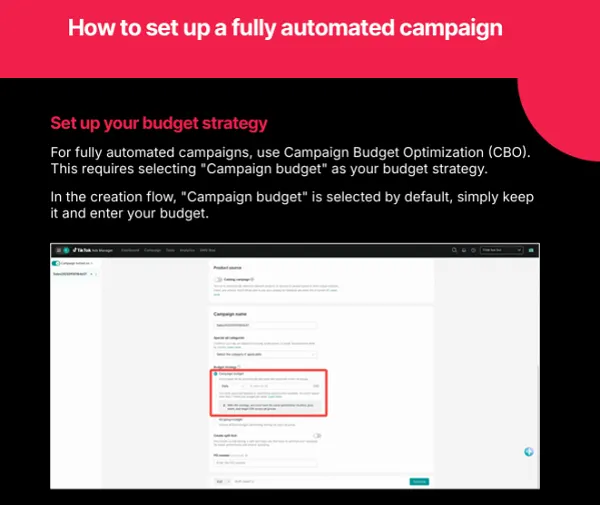
Based on TikTok’s guide and related Smart+ documentation, the publication includes practical guidance in three core areas:
- Campaign setup and prerequisites:
The Smart+ Web Campaigns guide explains that Smart+ is designed for performance-focused advertisers and is optimized toward traffic and conversion outcomes (e.g., sales), with automation intended to streamline launch and reduce manual configuration. [2] - Automation logic and what TikTok optimizes:
TikTok states that Smart+ uses machine learning to optimize delivery by automating components including bidding and audience delivery, aiming to show ads to users most likely to take action. [2][3] - Optimization and iteration guidance:
Social Media Today notes that the guide includes tips for improving campaign performance, and TikTok’s Smart+ materials emphasize iterative improvement through creative inputs and automated learning as part of ongoing optimization. [1][3]
Why TikTok is doing this
TikTok has been expanding its automation-focused advertising products, positioning Smart+ as a way for advertisers to capture performance outcomes with less manual workload while maintaining optional controls. In its Newsroom announcement on automation updates, TikTok explicitly described this direction as delivering “smarter ads” with more control and measurable outcomes, reinforcing Smart+ as a core product strategy. [4]
Publishing a detailed guide also helps standardize implementation and reduce adoption friction particularly for advertisers transitioning from manual campaign building to automated systems where optimization decisions are increasingly made by the platform’s models rather than by fixed targeting rules. [1][4]
Practical implications for advertisers and agencies
- Lower barrier to adoption for automated performance buying:
A structured guide reduces uncertainty about configuration and best practices for Smart+ Web Campaigns, especially for teams new to TikTok automation workflows. [1][2] - Greater emphasis on creative and measurement readiness:
Smart+ campaigns rely on machine learning optimization; TikTok’s materials highlight that strong creative inputs and clear performance objectives are central to effective automated delivery. [2][3] - Operational alignment for teams managing multiple accounts:
With standardized documentation, agencies can apply more consistent Smart+ implementation frameworks across clients, improving repeatability of setup and optimization processes. [1][3]
Overall, TikTok’s new guide formalizes how advertisers should deploy its AI-powered Smart+ campaigns particularly Smart+ Web Campaigns and frames automation as a core performance workflow in TikTok Ads Manager. The publication provides structured setup and optimization guidance while reinforcing TikTok’s broader push toward automated buying systems that can be tuned with optional controls rather than built entirely manually. [1][2][3][4]